Aprons Before Appetizers: The Thanksgiving Portraits Nobody Poses For
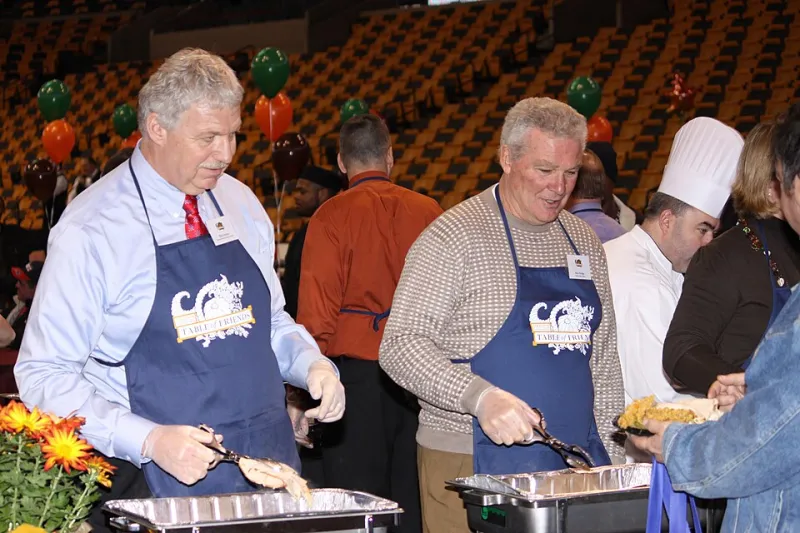
Photo: FEMA/Dennis Pinkham, Public domain, via Wikimedia Commons
There is a version of Thanksgiving that exists only in photographs taken after the guests arrive: everybody dressed, everybody smiling, somebody holding a platter of turkey like a trophy. I love those pictures. But they are not the whole story. The story starts earlier, in the quiet hour when the kitchen is still a workshop and nobody has thought to smooth their hair.
This November, in the week before Thanksgiving 2026, I spent a few evenings in kitchens around town making portraits of the people who show up first. The hosts. The aunts who arrive with a casserole and a roll of paper towels. The friend who says they are just stopping by and then stays to wash every dish in the sink. These are not the people we usually photograph on Thanksgiving. They are too busy making the day happen.
The Hour of Borrowed Chairs
The first portrait I made was not of a person. It was of six folding chairs leaning against a garage wall, waiting to be wiped down and carried inside. The host, a man named Doug, had borrowed them from his neighbor and his church and maybe one from the trunk of his own car. He stacked them with the care of someone handling fragile things.
When I asked if I could photograph him with the chairs, he laughed and said, I am not dressed for a portrait. He was wearing a fleece pullover and a pair of sneakers with paint on them. That was exactly why I wanted the picture. The chairs were not a prop. They were evidence of who he had called and what he had promised. The portrait was not about how he looked. It was about what he had already done.
The Onion Before the Onion Soup
In another kitchen, a woman named Carla stood at the counter with half an onion in front of her and a knife in her hand. She had been crying, but not because anything was wrong. It was the onion. Her apron said something about being a grandma, and there was flour on the counter in a shape that looked like a small map.
I asked her to keep chopping. She did. I made four frames of her hands, then one of her face when she looked up to answer a question about her mother's stuffing recipe. That last frame is the one I would print. It has the onion in the foreground, a little blurry, and her expression somewhere between tired and glad. It is not a flattering picture in the way a posed portrait is flattering. It is a true picture, which is a different thing.
The kitchen was messy. There was a stack of dishes in the sink, a bag of rolls on the floor, and a dog under the table who kept hoping for a dropped piece of celery. I did not move any of it. The mess was the point. This was not a set. It was a life being prepared for company.
The Kitchen Is the Group Photo
Most family portraits happen in the living room, or on the porch, or in front of the tree. The kitchen is usually saved for candid snapshots, the ones taken with a phone while somebody is reaching for a spoon. But the kitchen is where the holiday is actually assembled. It is where the turkey gets basted, where the pies cool, where the cousins sneak the first deviled egg. It is the room with the most labor in it.
So I started treating the pre-holiday kitchen like a group photo. Not a lineup, but a collection of small portraits that add up to one larger picture. The host checking the oven. The teenager peeling potatoes with earbuds in. The grandfather carrying in a card table and pretending it is not heavy. The borrowed chairs, the half-chopped onions, the apron strings tied in a hurry.
These pictures do not look like the holiday card. They look like the holiday itself, before it gets polished for public viewing. That is what makes them worth keeping.
What I Ask For, and What I Do Not
When I photograph the people who show up early, I keep it simple. I ask permission first. I stay out of the way. I do not ask anyone to pose or to pretend the kitchen is cleaner than it is. I use the window light that is already there and a quiet camera that does not make a production of itself.
The best frames usually happen when the person forgets I am there. They reach for a bowl. They taste the gravy. They stand at the sink with their shoulders dropped, taking a breath before the next thing. Those are the moments I am looking for. Not the smile for the camera. The exhale before the doorbell.
The Portrait You Did Not Know You Were Sitting For
By the time the guests arrive, the early helpers have already done the hardest part. They have made the beds, set the table, burned the first batch of rolls, and fixed the gravy. They have answered the texts about parking and pie. They are the reason the day feels easy to everyone else.
A portrait of them before the guests arrive is not a picture of waiting. It is a picture of giving. It says: this happened here, in this kitchen, before anyone thought to say thank you. That is a Thanksgiving story worth telling. And it usually starts on a Tuesday or Wednesday night, with an apron, a borrowed chair, and a counter full of good work still in progress.