The Cat Chose the Chair: Photographing Families With the Animals Who Run Them
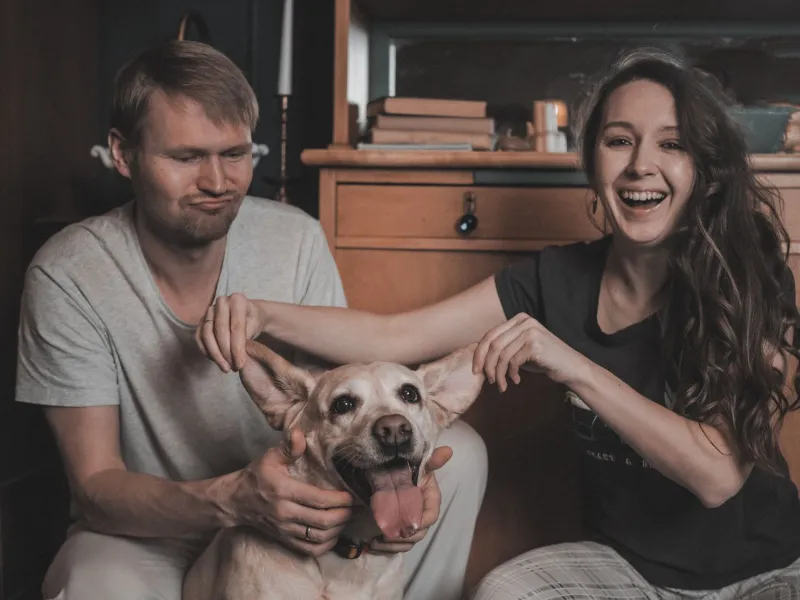
There is a moment in almost every family session where the humans stop performing and the animal takes over the room. Maybe it's a lab mix who hears a bag crinkle three houses away, or a cat who has decided that the one chair you wanted to use is now legally hers. Whatever it is, it's the part of the session I look forward to most, and it's the part that most families worry about beforehand.
So let me say the thing I say on the phone a lot: bring the animal. Bring the lizard, bring the geriatric beagle, bring the rabbit. The portrait will be better for it, and not only because pets are cute. Animals are terrible actors, which makes them the most honest thing in the frame.
The Animal Is Doing the Interview for Me
Before I lift the camera, I watch. A dog who keeps a body's width between himself and the teenage son is telling me something. A cat who only relaxes when the grandmother sits down is telling me something else. The family may have told me on the phone that they want "a nice, normal portrait," but the animal is running a live feed of the household's real hierarchy, and I'm taking notes.
Usually I use that information quietly. If the dog orbits the youngest kid, I'll build a frame around that pairing. If the cat has a chosen person, I put that person in the chair with the good window light and let the cat land where it lands. You can't pose a pet into a relationship that isn't there, and you don't need to — the relationships already exist, they're just rarely photographed.
Chaos Isn't the Enemy of the Frame
Here's what I tell clients who are apologizing for their dog before we've even started: the chaos is data, not noise. A blurry tail is fine. A dog who breaks a sit every nine seconds is fine. What is not fine is a family so focused on managing the animal that nobody is actually present.
My approach is to give the animal a job for the first ten minutes. A long sniff of the yard. A lap around the living room. A treat toss that lets the dog burn off the initial adrenaline spike (there's always one). Meanwhile, I'm shooting the humans loosely, not going for anything precious. By the time the dog has decided we're boring, we have our window.
Some practical handling notes from sessions:
- Shutter speed above everything else. I'd rather shoot at a higher ISO than miss a wagging tail or a cat's mid-pounce. Anything slower than about 1/250 will lose the motion that makes the picture feel alive.
- Get low. A portrait made at standing eye level with a corgi on the floor is a portrait of a corgi-shaped blob. Kneel, sit on the rug, lie on your stomach if the floor allows it.
- Continuous autofocus, animal eye detection if you have it. It earns its keep. A dog's eye is a small target and it moves.
- Skip the "sit, sit, sit" chorus. Repeating a command turns the whole room tense, and the dog reads tension instantly. One ask, then a treat, then move on.
- Brief the humans first. I ask families to look at the animal sometimes instead of the camera. Nine times out of ten, that's the frame they end up printing.
Follow the Light, Follow the Animal
Location choices for pet-inclusive portraits are usually made backward. Families pick the spot they like — the front porch, the big tree — and then try to fit the animal into it. I'd rather start with where the animal is calm and go from there.
In practice that means a few reliable setups. A north-facing window with a soft, even wash works beautifully for cats and older dogs who don't want to be moved. Open shade in a backyard gives you room for a dog to move without harsh shadows cutting across faces. Indoor sessions in the evening usually need one light, bounced, and even then I'm careful — hard flash on an animal's eyes makes them look startled, and startled is not a portrait.
If a family has a Brooklyn apartment with one good window and a nervous rescue, we work at that window. If they have a quarter-acre in suburban Phoenix and a border collie who needs to run, we shoot outside at the edges of the day. The light should serve the animal's comfort, not the other way around.
Center Stage or Side Detail
Not every pet needs to be the star. This is the judgment call that shapes the whole session, and it depends on what the family actually wants to remember.
When the pet is the emotional center — a senior dog, a child's first pet, an animal the family is quietly worried about — I give them the weight of the frame. Close, warm, uncluttered. The humans gathered around the animal rather than beside it. Those sessions tend to run long and go quiet, and I let them.
When the pet is a detail, I keep them loose in the frame: a cat on the back of the sofa, a dog's nose at the edge of the shot, the leash trailing out of frame. Those images age well. Ten years from now, the small presence in the corner is often the thing people cry about, because it's the detail they'd already started to forget.
What I've Learned From Doing This a Lot
Bring treats, but not the loud ones. Bring a lint roller, because I promise you I will notice the fur. Skip the matching outfits for the dog unless the dog genuinely enjoys it — a miserable animal in a sweater is not a holiday card, it's a hostage photo.
And expect the session to run about twenty minutes longer than planned. That's not a failure. That's the animal doing exactly what animals do, which is reminding everyone in the room that a family portrait was never going to be a performance. It's just a record of who was there.
The cat in the chair, in the end, was right. That chair had the light. She'd been running the household for years and she wasn't about to let a photographer rearrange the furniture.