Why I Don’t Send a Link: The Case for Looking at Your Portraits Together
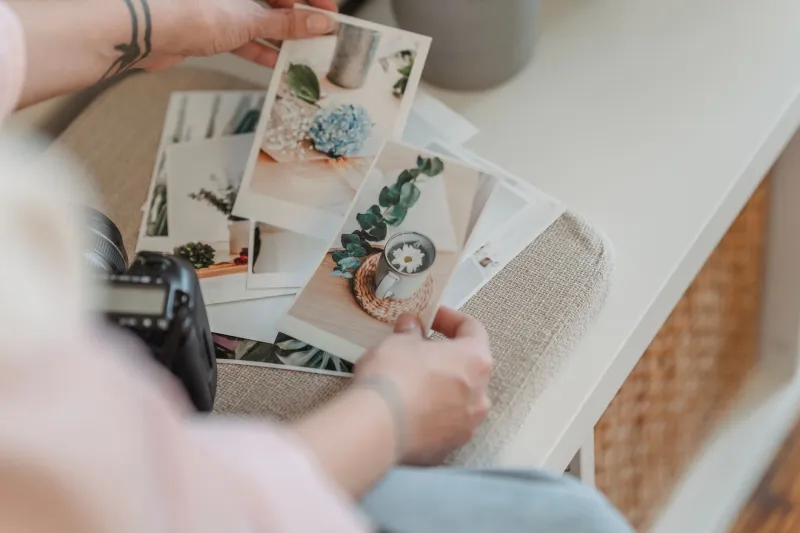
There is a moment in every reveal session when the room gets quiet. Not awkward quiet. The other kind. A parent leans in toward the screen, a kid stops swinging their legs, and somebody says, “Oh.” Just that. One syllable. Then maybe a hand finds another hand under the table.
That moment does not happen over a gallery link.
I know the convenience argument. I understand it. Links are easy to send, easy to forward to grandparents, easy to revisit at midnight when the house is finally still. But after years of making portraits for families, couples, and people marking one passage or another, I’ve become stubborn about one thing: the first real viewing should happen together, in the same room, with nowhere else to be.
The Link Makes People Scroll. The Room Makes Them Look.
A gallery link invites a certain kind of behavior. We open it on a phone. We swipe fast. We compare ourselves to the image next to us. We zoom in on the thing we dislike most—the neck, the chin, the arm, the smile that looks “weird” only because we have never seen ourselves from that angle before. Then we screenshot something and send it to a group chat, where it gets flattened into a reaction.
That is not looking. That is scanning.
In person, the pace changes. I put the images up large enough to see faces and hands and the way a father’s shoulder softens when his daughter leans into him. I don’t start with the obvious crowd-pleaser. I start with a frame that asks a question. Maybe it’s a quiet one—someone looking off-camera, a kid mid-laugh, a mother caught between fixing a collar and letting it go. The sequence matters. The silence matters. The fact that nobody can swipe away matters most of all.
The “I Hate My Face” Reflex Is Real
Almost everyone does it. The client sees the first image and says, “Ugh, I hate my face.” Or “I look so tired.” Or “Is that really what I look like?”
I don’t argue. Arguing with someone’s face is a losing game. What I do is slow the moment down.
“Okay,” I say. “Tell me what you see.”
Usually they point to a flaw that no one else in the room noticed. A crooked tooth. A line. A chin. Something they have been carrying around for years. I let them say it. Then I ask them to look at the person next to them—their partner, their kid, their friend—and tell me what that person is doing in the frame. Not what they look like. What they are doing.
That shift is small, but it changes everything. The client stops auditing themselves and starts reading the room. They notice the hand on the back. The kid’s fingers wrapped around a sleeve. The way the light lands on the wall behind them, the same wall they walk past every day without seeing it. The portrait comes back into focus as a scene rather than a mirror.
Looking Together Changes What Families Choose
When people view alone, they tend to choose the image that flatters them most. When they view together, they choose the image that tells the truth best.
I’ve watched a husband point to a frame his wife skipped over and say, “That one. That’s the one where you look like you.” I’ve watched a teenager roll their eyes at a picture, then quietly ask if they can have a copy for their room. I’ve watched grandparents tear up at an image that isn’t technically perfect—someone blinked, someone’s hair is doing its own thing—because it captures a version of the family that they recognize in their bones.
That doesn’t mean I ignore craft. I’m still thinking about light, composition, expression, the way a print will hold up on a wall. But craft is in service of recognition. The reveal is where recognition happens. It’s not a sales step tacked onto the end of the session. It’s the part where the portrait stops being mine and becomes theirs.
The Ordering Appointment Is Part of the Story
I know “ordering appointment” sounds like a dentist’s office. In practice, it’s closer to editing a family album together. We look. We talk. We narrow. We let some images go. That part can be hard, especially for people who are used to keeping every digital file “just in case.”
But choosing is not a chore. Choosing is how a family decides what it wants to remember. The image you print and hang is a small argument about what matters. The one you put in an album is a sentence in a longer story. The one you leave behind is not a failure; it’s just not the sentence you needed this year.
By the time we get to the order, the client isn’t guessing. They’ve seen the work large. They’ve heard themselves react. They’ve had the chance to say “I hate my face” and then, a few minutes later, say “Oh, actually, I love this one.” That arc is the whole point.
What I Owe the Person in Front of the Camera
A portrait session is a vulnerable thing. Someone stands in front of a lens and hopes to be seen accurately, or kindly, or at least not badly. The least I can do is not hand that vulnerability back as a link and a password.
So yes, I still make clients sit with their photos. Not to trap them. Not to force a sale. Because the sitting-with is where the portrait finishes its job. The image on the screen is only half the work. The other half is the person looking at it, finally seeing what the room already saw.
And usually, somewhere in that quiet, somebody says, “Oh.”
That’s the part I’m not willing to send in an email.